209 Stafford St, Worcester, MA 01603Get directionsMon–Fri 8AM–5PM · Sat 9AM–2PM
Diagnostics

Does a New ECU Need to Be Programmed? When Programming Is Required vs. Optional

Yes — a new ECU must be programmed and coded to your VIN. Which other parts need coding after installation, which don’t, and when a flash is an upsell.

Does a New ECU Need to Be Programmed? When Programming Is Required vs. Optional — Iron Wolf Motors, Worcester, MA

ECU programming — also called flashing, coding, or reprogramming — is required after replacing many of your car’s electronic modules and for certain factory software updates. But it’s optional, even unnecessary, when nothing is wrong and no update applies. Knowing the difference protects you from paying for work you don’t need. Here’s the honest breakdown.

First, what is an ECU — and what is “programming”?

Your car is run by many control modules: the engine ECU, the transmission TCM, the ABS module, body and comfort modules, and more. Programming means loading software onto a module; coding means configuring that module to your specific car — its VIN, options, and equipment.

When ECU programming is genuinely required

  • After replacing a module. A new ECU, TCM, or ABS unit often arrives blank and must be programmed and coded to your VIN to work at all.
  • Factory software updates / TSBs that fix real driveability, transmission, emissions, or safety issues.
  • After certain repairs that require recalibration — a throttle body, some sensors, or driver-assist cameras.
  • Many EV and hybrid fixes for battery, charging, and drive-unit systems.

When it’s optional (or just a “nice to have”)

  • The module works fine and there’s no stored fault.
  • No applicable update or TSB exists for your VIN.
  • A shop pushes a “performance flash” you didn’t ask for — that’s a want, not a need.

Which replacement parts need coding after installation?

Most searches for this come from someone holding a new part. The short version, by part:

  • Engine ECU, transmission TCM, ABS or body module — yes. These arrive blank or with generic software and must be programmed, then coded to the VIN and paired with the immobilizer before the car will run or the warnings clear.
  • A used module from another car — yes, and more. A salvage ECU carries the donor car’s VIN and immobilizer data. It has to be reset (“virginized”) or have your car’s data transferred to it; plugging it in as-is usually means a no-start.
  • Battery on many European cars — a small coding step. BMW, Audi, VW and Mercedes want the new battery registered so the charging system treats it as new. It is not a reflash.
  • Injectors on many modern diesels and direct-injection engines — yes. Each injector has a correction code that has to be entered so the ECU fuels it correctly.
  • Throttle body, steering-angle sensor, some suspension sensors — a relearn or calibration, not programming. It still needs a scan tool.
  • Driver-assist cameras and radar — a calibration, often required after a windshield, bumper or alignment job.
  • Brakes, filters, most sensors, bulbs, mechanical parts — no. If a shop wants to “program” after a pad job, ask what fault or update it is for.

Reflashing is not the same as performance tuning

A factory reprogram is about correct, reliable operation — fixing known bugs and restoring the car to how the manufacturer intended. Performance tuning is a separate, optional choice with real trade-offs for warranty, emissions, and longevity. We focus on manufacturer-spec programming that keeps your car compliant.

How we handle it

We check for applicable factory updates, program and code replacement modules to your VIN, and recalibrate systems after repairs — dealer-level work without the dealer wait. See our ECU programming & reprogramming service, backed by full electrical & diagnostics. If your problem started as a warning light, diagnosis comes first — we only program when it’s actually the fix.

Frequently asked questions

Does a new ECU need to be programmed?

Almost always, yes. A replacement engine computer usually arrives blank or with generic software, so it has to be loaded with the right calibration for your car and coded to its VIN and immobilizer so it recognizes the keys and the other modules. A used ECU from another car has the same problem: it still carries the donor car’s identity until it is reprogrammed.

Do you have to reprogram after installing a new part?

Only for some parts. Control modules (ECU, TCM, ABS, body modules) need programming and coding; batteries on many European cars, diesel injectors and driver-assist cameras need a coding or calibration step; brakes, filters and most mechanical parts need nothing.

Can I install a used ECU without reprogramming?

Usually not. A used ECU holds the donor car’s VIN and immobilizer data, so it has to be reset or have your car’s data transferred before it will start the engine. Only an exact part-number match that has been properly cloned is plug-and-play.

What does “ECU programming not supported” mean?

It usually means the scan tool being used cannot program that module — a generic tool, or one without the manufacturer’s software. It does not mean the module cannot be programmed; it needs factory-level software.

Does my car need programming after a new battery?

Many European cars need a quick battery “registration” (so the charging system knows the new battery), which is a small coding step — not a full reflash. We’ll do exactly what your car requires and nothing more.

Will programming fix my check-engine light?

Only if a software bug or a module that needs coding is the actual cause. Often a light is a failed sensor or mechanical issue, so we diagnose first and program only when it’s the right repair.

Can you program European and EV modules?

Yes — we program and code a wide range of European makes and EV/hybrid systems that usually have to go back to the dealer.

What’s the difference between flashing and coding?

Flashing loads software onto a module; coding configures that module to your specific car — its VIN and options. A new module often needs both.

Is a “performance tune” the same as factory programming?

No. A factory reflash restores correct, reliable operation and keeps you compliant; a performance tune is a separate, optional choice with warranty and emissions trade-offs.
Have a question about your car?

We’ll give you a straight answer — book online or call us today.

From the workshop

We wrote one of these up in full

Failed PCV valve cover from a Maserati Ghibli held in a gloved hand, its inside coated in oily yellowish sludge, next to the open valve housing with its spring on the engine
Maserati Ghibli

Maserati Ghibli Check Engine Light: A Failed PCV Valve, Coated in Sludge

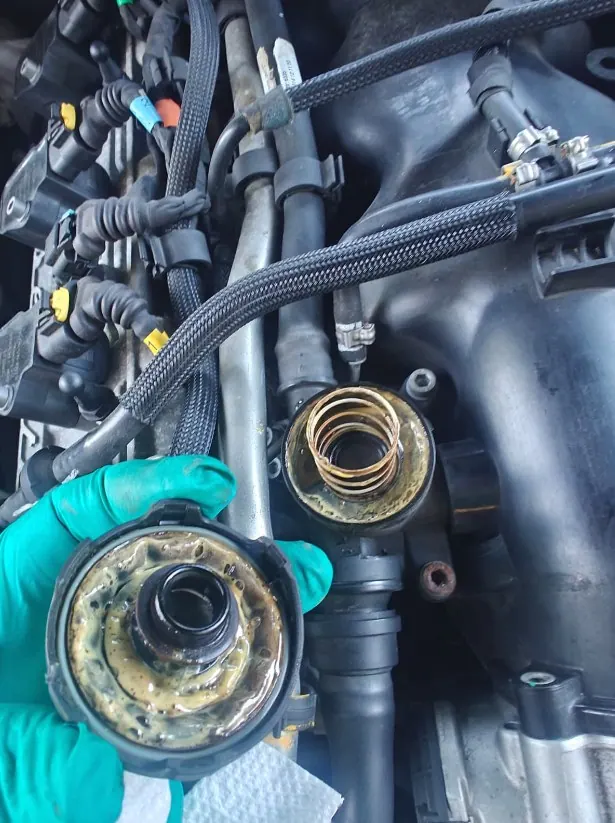
A Maserati Ghibli came in with the check engine light on. The cause was the PCV valve — the small diaphragm valve that controls crankcase ventilation. With its cover off, the inside was coated in oily, yellowish residue and the valve had failed. A new PCV valve fixed it. Here is what it looked like and why such a small part turns the light on.

Read the write-up
Gloved hand holding a wiring harness behind the front bumper cover of a 2023 Tesla Model Y, the protective loom and insulation chewed through by mice
2023 Tesla Model Y

Tesla Model Y Light Malfunction Warning: A Mouse Nest and a Chewed Harness

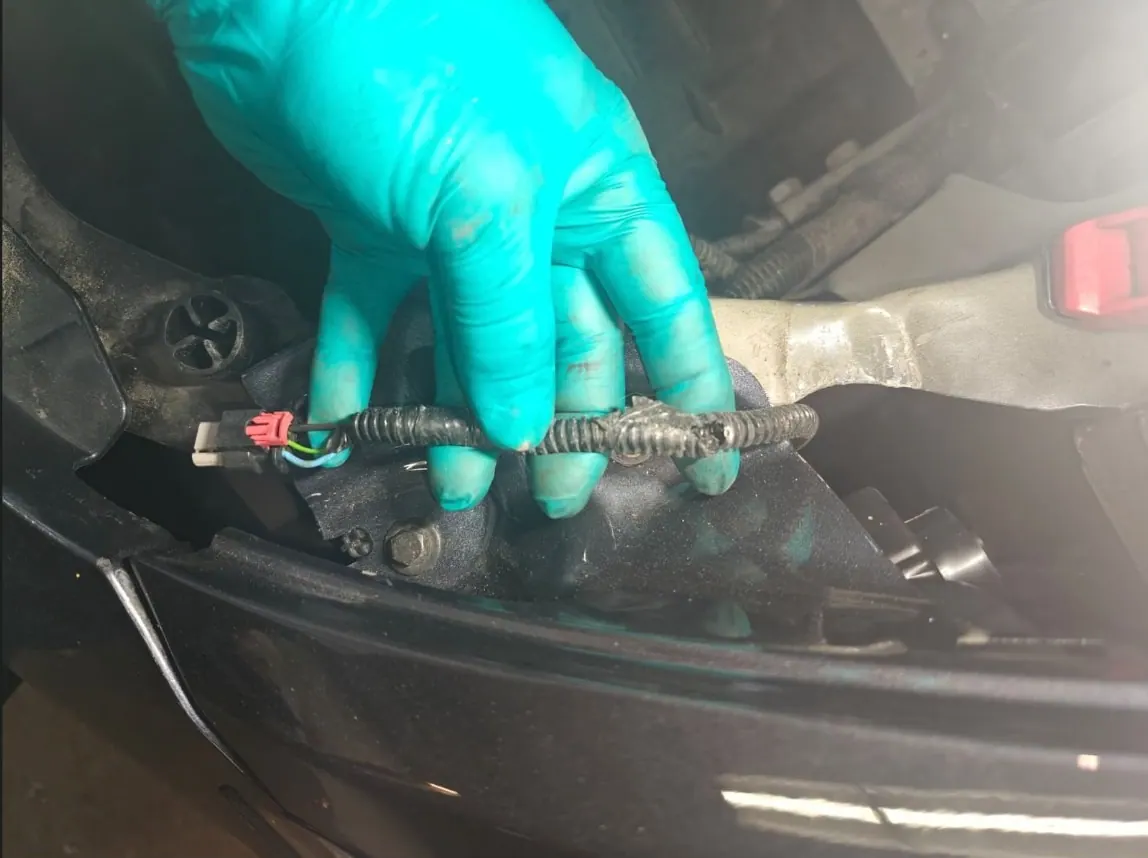
A 2023 Tesla Model Y came in with a light malfunction warning on the display. Behind the front bumper cover we found a mouse nest — and a lighting harness chewed through to the copper. We repaired the harness and the warning cleared. Here is what rodent damage looks like on a modern car.

Read the write-up
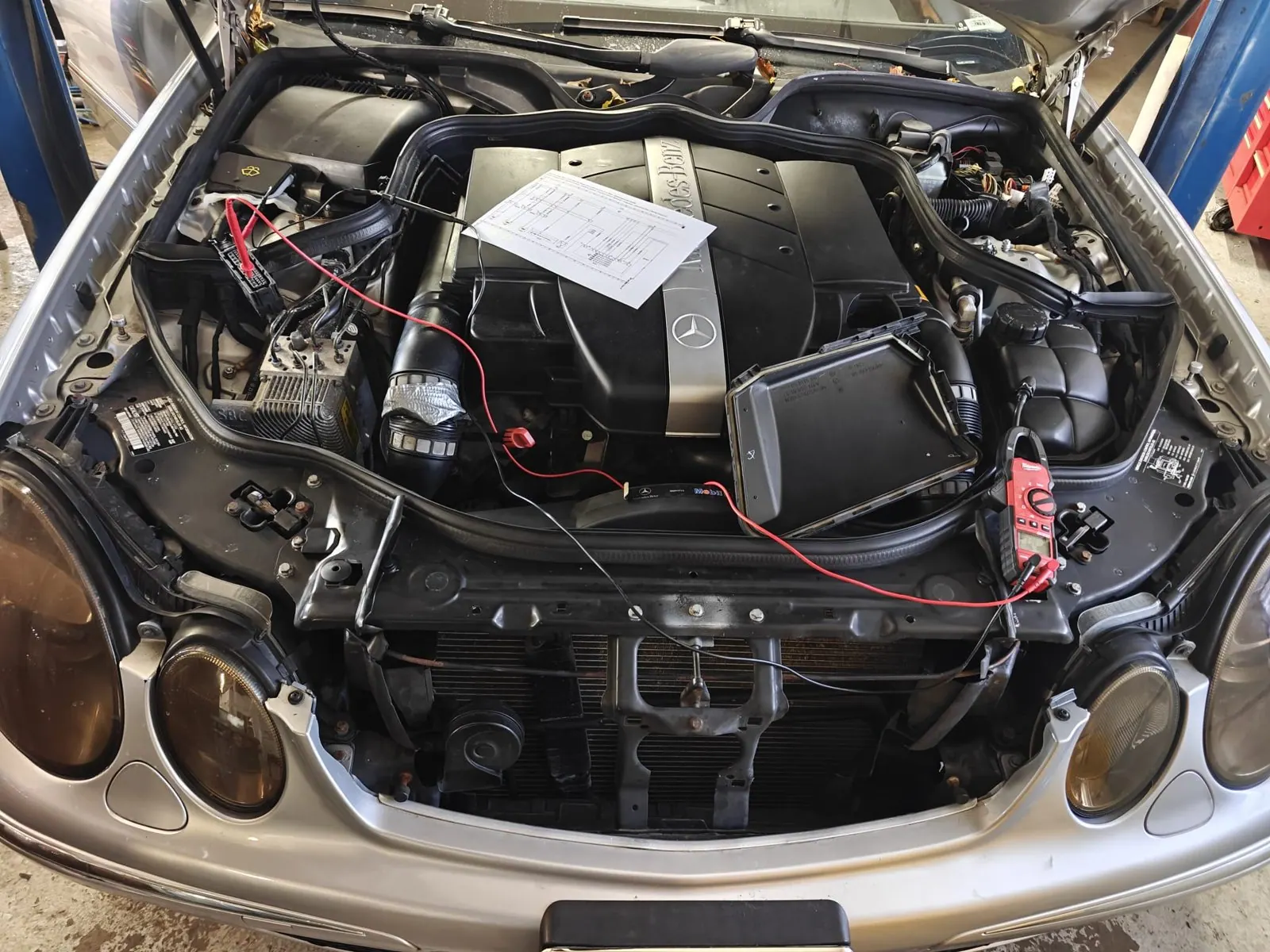
Engine bay of a silver Mercedes-Benz E320 wagon with a printed wiring diagram on the engine cover, test leads back-probing the SBC brake unit connector and a clamp multimeter on the radiator support
Mercedes-Benz E320 Wagon

Mercedes E320 Wagon SBC Brake Fault: Traced to a Corroded Connector

A Mercedes-Benz E320 wagon came in with an SBC brake system fault. The SBC unit itself is the expensive guess; we traced the circuit with the wiring diagram and a multimeter instead, and found a corroded connector in the rear of the car with green and orange corrosion on its terminals. The connector was repaired and the fault was gone.

Read the write-up
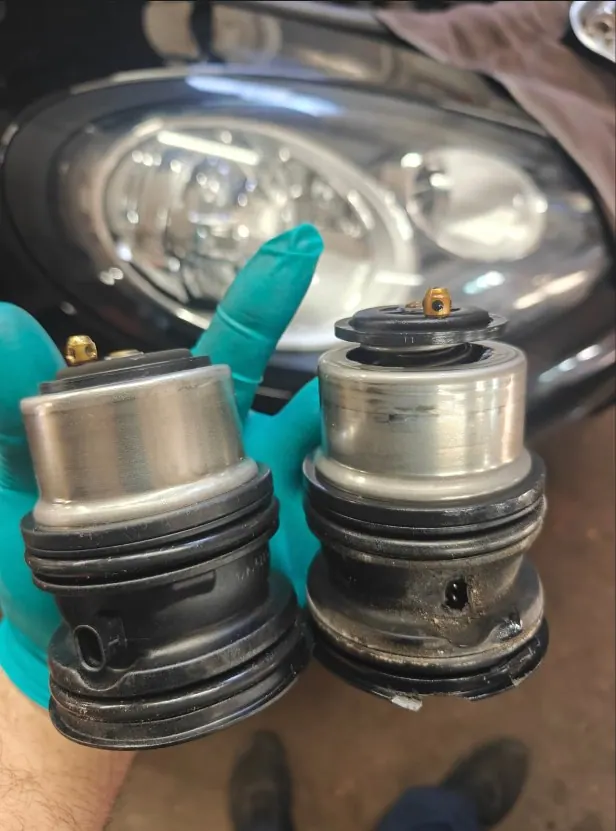
Gloved hand holding the new OEM coolant thermostat next to the old, dirty thermostat from a Porsche Panamera, in front of the car’s headlight
Porsche Panamera

Porsche Panamera Check Engine Light: Thermostat Stuck Open

A Porsche Panamera came in with the check engine light on. The cause was a coolant thermostat stuck open, so the engine was not reaching its proper operating temperature. We replaced it with an OEM thermostat and performed a complete coolant system flush. Old and new side by side.

Read the write-up
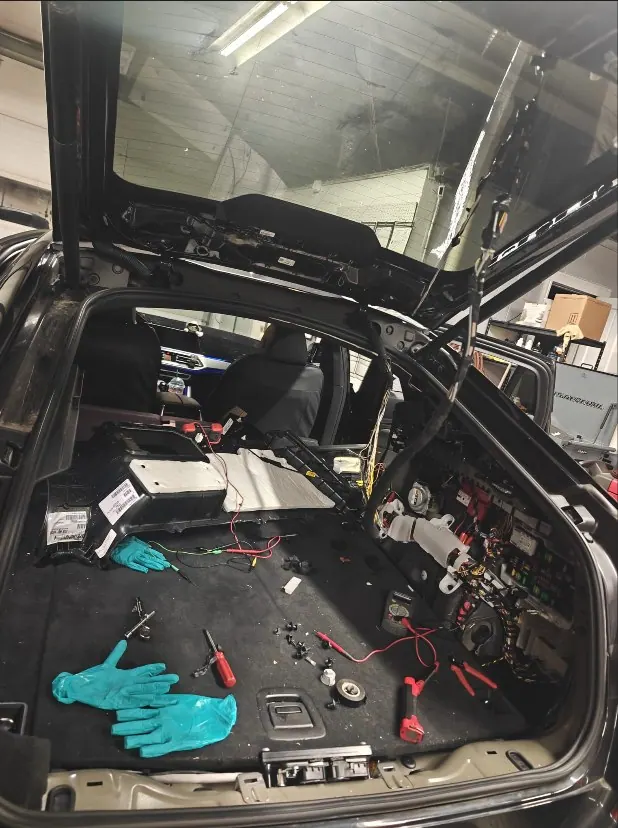
Cargo area of a 2021 BMW X6 with the trim removed, wiring and fuse box exposed, test leads and tools laid out for tracing a damaged harness
2021 BMW X6

BMW X6 License Plate Lights Out: Mouse Damage, a Shorted Harness and a Body Module Fault

A 2021 BMW X6 came in with the rear license plate lights not working — and it turned into an unexpected repair. The cause was again a mouse nest. The chewed harness had shorted, and the body control module set a hard fault and stopped switching the lights on. We traced and repaired the harness, then restored the module with a software update.

Read the write-up
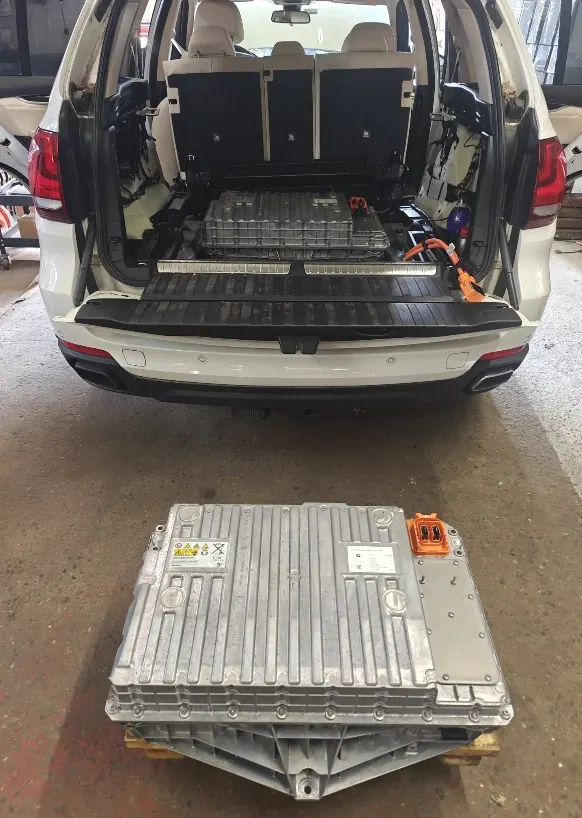
High-voltage battery pack from a 2016 BMW X5 xDrive40e on a pallet on the shop floor behind the open cargo area of the white SUV
2016 BMW X5 xDrive40e

BMW X5 xDrive40e Hybrid Battery Failure: Confirmed Online, Replaced and Programmed

A 2016 BMW X5 xDrive40e plug-in hybrid with a hybrid system fault. An online vehicle diagnostic confirmed the high-voltage battery had failed. We replaced the HV battery under the cargo floor and programmed the vehicle order so the car accepts it. Here is the job.

Read the write-up
Top of the six-cylinder engine of a 2015 BMW 535i with the valve cover removed, showing the camshafts, valve springs, eccentric shaft and timing chain
2015 BMW 535i

BMW 535i: Failed PCV Valve and Camshaft Adjuster — Valve Cover, Actuator and Relearn

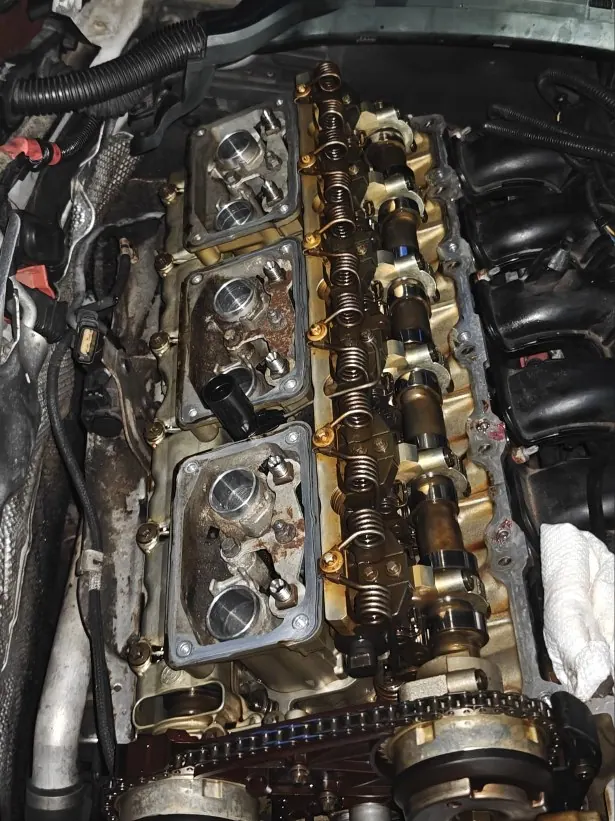
A 2015 BMW 535i with two failures at the top of the engine: the camshaft adjuster valve and the PCV valve. On this engine the PCV valve is built into the valve cover, so the repair was a new valve cover assembly and a new actuator, followed by the camshaft actuator relearn procedure. Here is the engine with the cover off.

Read the write-up
White first-generation Audi R8 strapped to a flatbed tow truck outside Iron Wolf Motors in Worcester, MA, arriving as a no-start
Audi R8 4.2 FSI V8

Audi R8 V8, Towed In After Three Shops: Recovering Two Silent ECUs and Restoring the Factory Setup

A first-generation Audi R8 4.2 V8 arrived on a flatbed, not starting. It had been ECU-tuned, the owner wanted it back to factory, and three shops had already tried. Their attempts had corrupted the car’s configuration: both engine ECUs no longer communicated and the immobilizer would not let the engine start. We recovered both ECUs, reprogrammed the immobilizer and restored the original factory configuration.

Read the write-up
Dark blue Tesla Model 3 strapped down on a flatbed trailer at dusk, delivered to Iron Wolf Motors in Worcester, MA after a complete high-voltage shutdown
Tesla Model 3

Tesla Model 3, Dead High Voltage: Why We Inspected Before Replacing the Pyro Fuse

A Model 3 arrived on a flatbed with no high voltage and a blown pyro fuse. The obvious repair was the fuse. We inspected the PCS and the high-voltage harness first — and found the rear drive unit cable worn through against the body.

Read the write-up

See all documented repairs