
The first properly cold morning of the year always brings the same phone calls. The car was fine yesterday, and today it either cranks slowly, clicks, or does nothing at all. Most of the time the battery is to blame. But “most of the time” is how people end up buying a new battery for a car whose real problem is the alternator, and then buying another one two weeks later.
Our fall car maintenance checklist explains why cold is so hard on batteries and why you should test yours before winter. This guide picks up where that one stops: the car will not start, so what is actually wrong, how do you tell the battery, alternator and starter apart, and what should the fix involve?
Why cold mornings expose weak batteries
Two things happen at once when the temperature drops. The chemical reaction inside a lead-acid battery slows, so it can deliver less current. At the same time, engine oil thickens, so the starter needs more current to turn the engine over. A battery with plenty of reserve copes with both. A battery that was already tired — often because a hot summer did the damage — does not, and the first cold morning is when it finally shows.
That is why batteries seem to fail without warning. The warning was there all along. It just took a cold morning to make it visible.
Read the symptoms: what the car is telling you
Before anyone reaches for jumper cables, pay attention to exactly what happens when you turn the key or press the start button. Each of these points somewhere different.
A slow, labored crank
The engine turns over, but sluggishly, as if it is struggling. This is the classic weak-battery symptom. It can also be caused by corroded or loose battery terminals or a poor ground connection, which stop the full current reaching the starter even when the battery itself is fine. If the car eventually starts, do not assume the problem has gone away. Get the battery tested that week.
Rapid clicking and flickering dash lights
A fast “click-click-click” with the dash lights dimming or flickering means the battery has enough charge to engage the starter solenoid, but not enough to keep it engaged once the starter motor tries to draw current. That is a discharged or failing battery in almost every case.
One loud click, and the lights stay bright
A single solid click with the dash and headlights staying at full brightness points away from the battery. The battery is delivering power, but the starter is not turning. The usual suspects are the starter motor or its solenoid, or a bad connection in the heavy starter cable. A starter that works on the third try is not fixed. It is failing.
Nothing at all — no lights, no sound
Complete silence usually means a battery that is completely flat, or a connection that has come loose or corroded through at the terminal. Less often it is a main fuse or a failed ground. Check the terminals before anything else. A clamp that can be twisted by hand is a common cause and an easy fix.
Starts with a jump, dead again the next morning
This is the pattern that wastes the most money, because there are three different causes and they need three different fixes:
- The battery no longer holds a charge. It accepts a jump, but it has lost capacity and cannot store enough energy to survive the night.
- Something is draining it with the car off. That is called parasitic drain, and it is covered below.
- The alternator is not recharging it. The car runs on the battery until the battery is empty.
Battery light on while driving, dimming lights, or the car dies on the road
These point to the charging system rather than the battery. When an alternator stops charging, the car runs on battery power alone. The lights and blower get weaker, warning lights appear, and eventually the engine stalls. A squeal on cold mornings can be a slipping drive belt or a worn tensioner rather than the alternator itself, which is why the belt gets checked before anyone condemns the alternator.
Cranks at normal speed but will not fire
If the engine spins over at a healthy speed and simply never catches, the battery and starter have done their job. The problem is fuel, ignition, a sensor, or on many modern cars the immobilizer refusing to recognize the key. That calls for a proper scan rather than a new battery — see our guide to what a check engine light actually means, or our write-up of an Audi R8 no-start that turned out to be its engine computers.
What a multimeter can and can’t tell you
If you own a simple voltmeter, two readings are useful. With the car parked for a few hours, a healthy, fully charged 12-volt battery reads about 12.6 volts. Around 12.4 volts it is partly discharged, and at about 12.0 volts or below it is heavily discharged. With the engine running, a working charging system typically holds somewhere around 13.5 to 14.7 volts.
There are two catches. First, voltage measures charge, not capacity. A worn battery can read a perfect 12.6 volts and then collapse the moment the starter asks it for current. Second, many modern cars use “smart” charging that deliberately varies the alternator output, so a reading below 13.5 volts is not automatically a fault on those cars. A voltmeter tells you something is wrong. It rarely tells you what.
How we test it properly
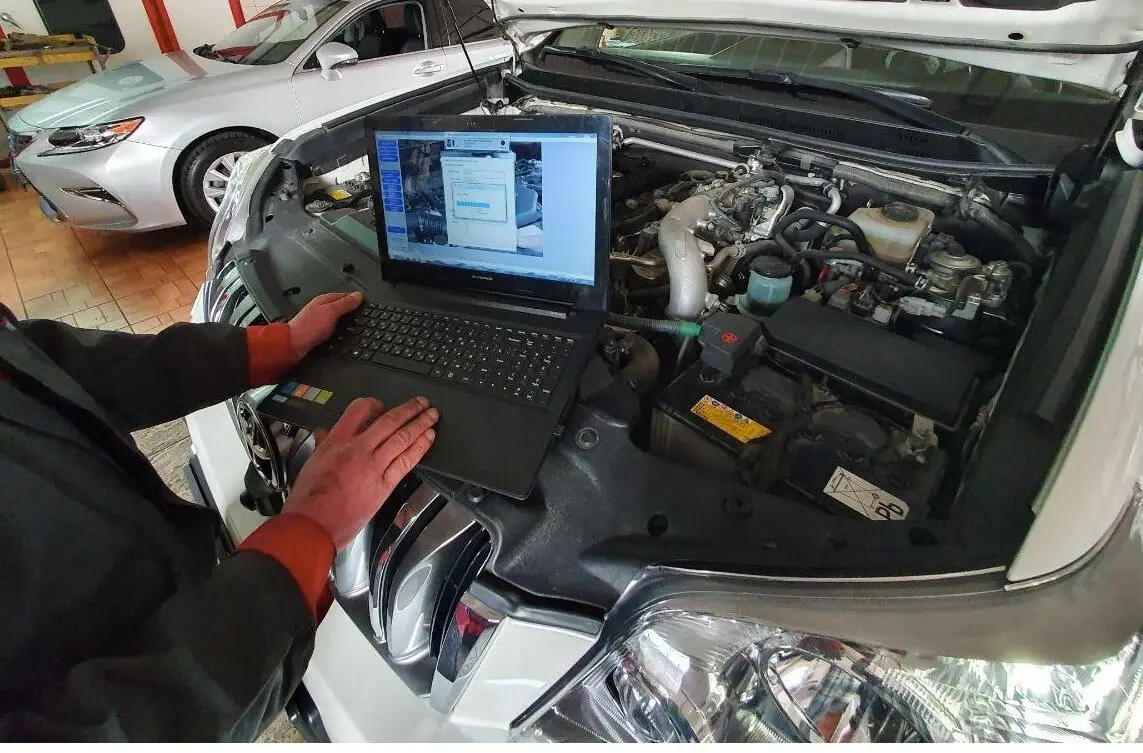
A proper starting and charging test takes the guessing out of it. When a car comes in with a no-start or a battery you do not trust, this is what we check:
- Battery condition under load. A load or conductance test that measures how much cranking ability the battery has left, not just its voltage.
- Charging output. Alternator output at idle and under load, with the lights, blower and rear defroster switched on, so a weak alternator can’t hide.
- Starter draw. How much current the starter pulls while cranking. A starter that draws too much is wearing out, and it will flatten even a good battery.
- Cables, terminals and grounds. A voltage-drop test across the main cables and ground straps finds the corroded connection that a visual check misses.
- Parasitic drain. If the battery keeps going flat overnight, we measure what the car draws with everything switched off and locked.
The quick scan is free, and a full diagnosis is $150/hr. You get a written quote before any part is replaced, so you are paying for the actual fault, not for parts that might fix it.
Parasitic drain: the battery that dies overnight
A modern car is never completely off. Its computers, alarm and keyless entry system keep drawing a small amount of current while it is parked, and that is normal. The problem comes when something keeps drawing more than it should — a module that never goes to sleep, a light that stays on in the glovebox or trunk, a sticking door switch, or an aftermarket accessory such as a hardwired dash camera or remote starter.
In summer a healthy battery can often survive a small drain. In winter, with less reserve and a harder start every morning, it cannot. Finding a drain takes patience: on many European cars the modules take a while to shut down after the car is locked, and measuring too early gives a false reading. Once the drain is found, it is usually removed by repairing or disconnecting the cause, not by fitting a bigger battery.
Replacing the battery: getting the right one matters
If the battery is the problem, the replacement is not always a simple swap.
- Match the type. Cars with automatic start-stop are designed for an AGM battery (some use an EFB). Fitting a cheaper conventional flooded battery shortens its life, sometimes dramatically, and can stop the start-stop system working properly.
- Match the capacity. A battery that is too small for the car’s electrical load will struggle in exactly the conditions where you need it most.
- Register it on European cars. BMW, Mercedes-Benz, Audi, VW, Volvo and others track the age and type of the battery and adjust charging to suit. If a new battery is not registered, the car keeps charging it as if it were the old, worn one. We do this with the same software the dealers use — ISTA+, Xentry, ODIS and VCDS, and VIDA (see our equipment). More in ECU programming: when it’s required vs. optional.
- Expect some resets. On some cars, disconnecting the battery means one-touch windows, the sunroof or the steering angle sensor have to be re-initialized afterward. A shop that knows the car does this as part of the job.
Jump-starting a modern car safely
A jump is a reasonable way to get a car moving, provided it is done correctly. Modern cars are full of electronics that do not like voltage spikes.
- Use the jump points the manufacturer provides. Many European cars keep the battery in the trunk or under a seat and provide dedicated positive and ground posts under the hood. The owner’s manual shows where they are.
- Connect in order: positive on the dead car, positive on the donor or jump pack, negative on the donor, then the final negative clamp onto bare, unpainted metal or the ground post on the dead car — not directly onto the dead battery.
- Let the donor run for a few minutes before you try to start the dead car, and keep the first attempt short.
- Remove the cables in reverse order.
One more thing: a 20-minute drive after a jump does not fully recharge a deeply discharged battery. The alternator is designed to top a battery up, not bring it back from empty. A proper charge on a battery charger, followed by a test, is the only way to know whether the battery is worth keeping.
If you drive a hybrid or an EV, check the owner’s manual before using it to jump another car. Many manufacturers say not to. Electric cars have their own winter battery issues, covered in our guide to owning a Tesla in a New England winter.
Alternators and starters: repair or replace?
When the alternator or starter is the cause, the part itself is only half the cost. On some engines the starter sits in plain view and comes out in under an hour. On others, particularly some V6 and V8 engines, it is tucked under the intake manifold, and getting to it is most of the job. That difference is why we quote alternator and starter work individually, at $199/hr labor plus parts, in writing before we start.
Quality remanufactured units are a sound choice for many cars. On some European models we recommend new or original-equipment parts, because the alternator communicates with the car’s energy management system and a cheap unit can cause charging faults of its own. Our guide to aftermarket vs. OEM parts explains how we make that call.
Get it tested before it leaves you stranded
If your car has been cranking slowly, needed a jump, or shows a battery warning, bring it in while it still starts. A battery, alternator and starter test takes a fraction of the time a roadside breakdown does, and it tells you exactly which part is at fault.
Book electrical diagnostics, or ask for a battery test as part of a general maintenance visit. For BMW, Mercedes-Benz, Audi, VW and Volvo, battery replacement includes registration as standard — see our European specialist service.
Frequently asked questions
How do I know if it’s my battery or my alternator?
If the car starts with a jump and keeps running, but is dead again after sitting, the battery is the more likely cause. If the battery warning light comes on while you are driving, the lights dim, or the car stalls on the road, the alternator is the more likely cause. A charging system test measures both and settles it in minutes.
How long does a car battery last in Massachusetts?
Typically three to five years. Hot summers, lots of short trips and cars that sit for days at a time all shorten that. Once a battery is three years old, it is worth having it load-tested every autumn rather than waiting for the first cold morning to find out.
Why does my car start after a jump but die again the next morning?
There are three common causes: the battery has lost capacity and can no longer hold a charge, something in the car is draining it while it is parked, or the alternator is not recharging it while you drive. Each needs a different fix, which is why testing before buying parts saves money.
Does a new car battery need to be programmed?
On many European cars, yes. BMW, Mercedes-Benz, Audi, VW, Volvo and others need the new battery registered to the car so the charging system knows it is new and what type it is. Skipping that step can shorten the new battery’s life considerably. Most domestic and Asian cars do not need it.
Can I jump-start a frozen car battery?
No. A deeply discharged battery can freeze in cold weather, and a frozen battery can crack or rupture if you try to jump or charge it. If the case is bulging or cracked, or you suspect the battery has frozen, have it replaced instead.
How much does it cost to test a car battery at Iron Wolf Motors?
The quick scan is free. If the fault needs proper diagnosis — a parasitic drain, an intermittent no-start, or a charging fault — full diagnosis is $150/hr. Any repair or replacement is quoted in writing before work starts.


