

Potholes are a winter product. Water runs into cracks in the pavement, freezes overnight and expands, then thaws during the day and leaves a gap underneath. Traffic breaks the weakened surface, and the hole grows with every cycle. Central Massachusetts goes through a great many of those freeze-thaw cycles each winter, which is why the roads deteriorate so quickly between December and March.
Most potholes cost you nothing more than a jolt. A deep one hit at speed can bend a rim, break a tire, knock the alignment out or bend a steering part, and some of that damage does not show itself straight away. This guide covers what to check after a hard hit, what each symptom means, and the order repairs should be done in.
Right after the hit: the five-minute check
If the impact was hard enough to make you wince, pull over somewhere safe and take a look. You are checking for the damage that makes the car unsafe to keep driving.
- Look at both sidewalls of the tire that took the hit — the inner one too, if you can see it. A bulge or bubble is the most important thing to find.
- Look at the edge of the rim. A visible dent or flat spot on the lip is a bent rim.
- Watch the dashboard for a tire pressure warning in the next few minutes. A fast pressure loss means a damaged tire or a bent rim that is no longer sealing.
- On the way home, notice the steering wheel. Is it still straight when you drive straight? Does the car pull?
- Listen. A new clunk, knock or rattle over bumps is a sign that something in the steering or suspension has been damaged.
What a pothole can damage, part by part
Tires: the bulge you must not ignore
When a tire is pinched between the rim and the edge of a pothole, the cords inside the sidewall can break. Air pressure then pushes the weakened area outward into a bulge. A sidewall bulge cannot be repaired, and the tire can fail suddenly, especially at highway speed. Replace it, and use the spare until you do.
Low-profile tires, common on European cars and on larger wheels, are the most vulnerable, because there is so little sidewall to absorb the hit. Underinflation makes it worse. Cold weather lowers tire pressure — about 1 PSI for every 10°F — so tires that were correct in October are often low by January. Keeping them at the door-jamb pressure is the cheapest protection there is.
Run-flat tires and TPMS can hide the damage
Many BMW, Mercedes-Benz and MINI models leave the factory on run-flat tires, which are built to keep supporting the car for a limited distance after losing pressure. That is useful on the side of the highway, but it also means a run-flat that was damaged in a pothole can feel completely normal to drive. The tire pressure warning may be the only sign, and if it comes on after a hard hit, treat it as a damaged tire until it has been inspected. A run-flat that has been driven flat or has sidewall damage has to be replaced.
The same goes for any car: a TPMS light that appears in the days after a pothole is not just the cold. Check the pressure, and if one tire keeps losing air, have the tire and rim looked at together, because the leak is often at a bent rim lip rather than in the tread.
Rims: bends and cracks
A bent rim shows up as a vibration through the steering wheel or seat at highway speed, or as a tire that slowly loses air over days because the bent lip no longer seals against the tire bead. Many bends can be straightened and checked for run-out, so the wheel turns true again. Bent rim repair is $119.89, and remounting and balancing the tire is $19.89 — usually far cheaper than a new alloy wheel, especially a factory wheel on a European car.
Cracks are a different matter. Whether a crack can be repaired depends on where it is and how far it runs. A crack in a spoke or near the center of the wheel means replacement. Where a crack in the outer rim can be repaired safely, cracked rim welding is $159.89 — and where it cannot, we will tell you so and recommend a replacement wheel. Our guide on curb rash, bent and corroded rims goes into the decision in more detail.
Alignment
A hard hit can shift the alignment angles enough to make the car pull, leave the steering wheel off-center, or wear the tires unevenly. Even when the car seems to drive normally, a small change in toe can take thousands of miles off a set of tires. Our guide to why wheel alignment matters explains the angles and the warning signs.
Tie rods and steering
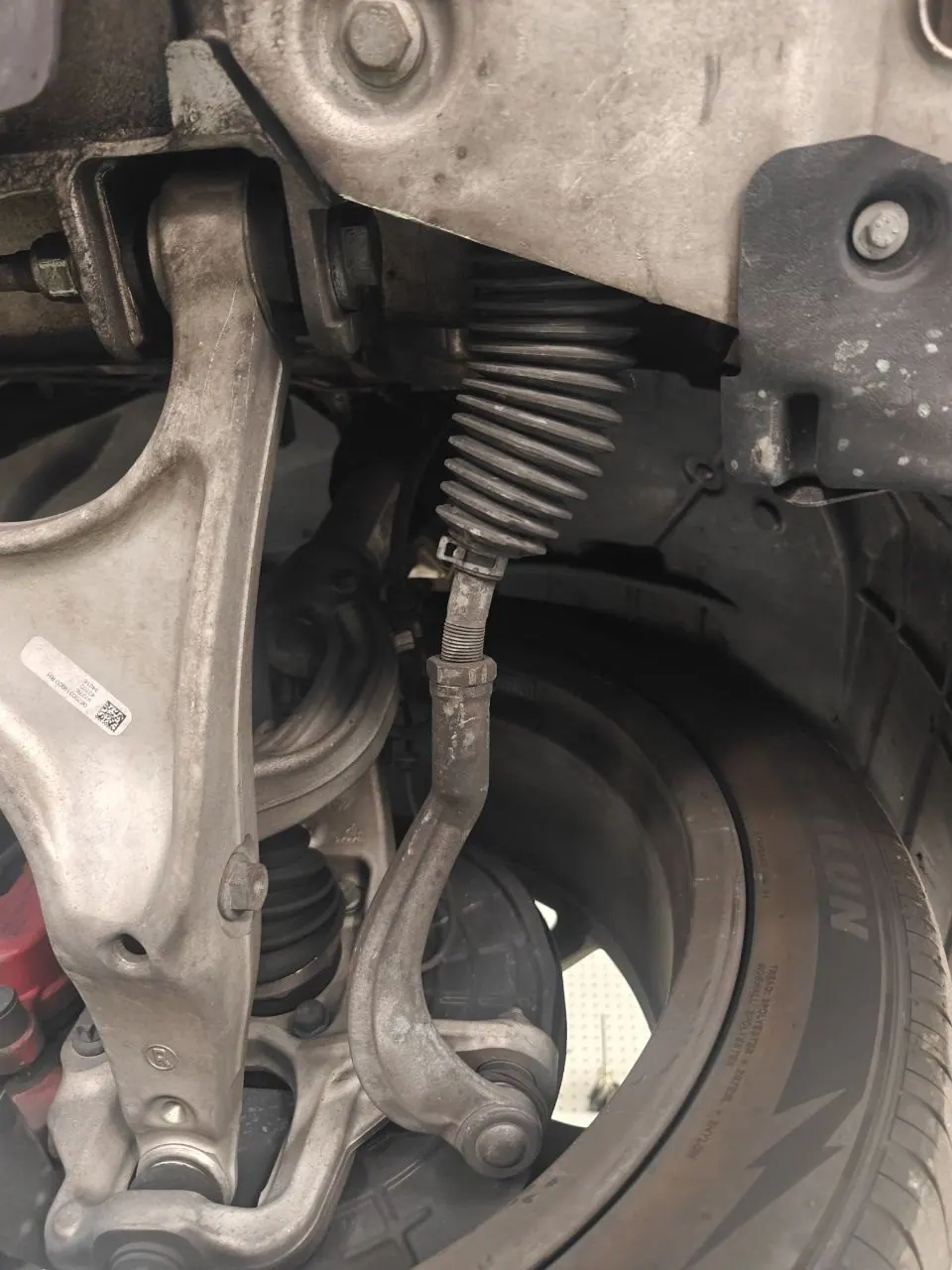
The tie rods connect the steering rack to the wheels. A heavy impact can bend one, and a bent tie rod changes the steering geometry in a way an alignment cannot properly correct. Adjusting a bent tie rod to make the alignment numbers look right hides the damage instead of fixing it.
We saw exactly this on a Maserati Levante that came in for nothing more than an alignment. With the wheels off, both outer tie rod ends were visibly bent, so we replaced them first and aligned the car afterward. The full write-up, with photos, is here: Maserati Levante: why we replaced the tie rod ends first.
Suspension
Control arms, ball joints, struts and shocks, strut mounts and sway bar links all take the force of a pothole strike. A bent control arm or a damaged strut can cause a pull, a clunk over bumps, or a car that wanders on the highway. Heavy cars feel it most. On Tesla Model 3 and Model Y, the front upper control arms are a known wear item that rough roads accelerate — see independent Tesla service in Massachusetts.
Reading a vibration after a pothole
Vibrations are one of the most common complaints after a hard hit, and when they happen tells you a lot about the cause:
- Vibration that builds with speed, usually from about 50 mph up → a bent rim or a lost balance weight. A balance check and a run-out check find it.
- Vibration or pulsing only when you brake → brake rotors, not the wheel. Our guide on brake pads, rotors and fluid covers it.
- A wobble or shimmy at low speed → possibly a damaged tire with a shifted internal belt. That tire needs inspecting before it is driven far.
- A pull to one side, with the steering wheel off-center → alignment, possibly with a bent steering or suspension part behind it.
Filing a pothole claim in Massachusetts
Massachusetts law does allow claims for damage caused by a defect in a public road, but the rules are strict and depend on who maintains the road. This is a general overview, not legal advice.
- City and town roads. Claims are governed by Massachusetts General Laws chapter 84. Written notice generally has to reach the city or town within 30 days, recovery is capped at $5,000, and you have to show the municipality knew, or should have known, about the defect and had a reasonable chance to repair it.
- State highways. Claims against the Commonwealth for road defects are much narrower, and property damage to a vehicle is generally not recoverable. A pothole inside an active construction zone can be different, because the contractor may be responsible.
- Check your own policy. Collision coverage may pay for pothole damage, minus your deductible.
Whatever route you take, documentation is what makes a claim possible: photos of the pothole and its exact location, the date and time, photos of the damage, and a written repair estimate or itemized invoice. We provide a written quote before any work and an itemized invoice afterward, which is what an insurer or city will ask for. Report the pothole too, to your city or town or to MassDOT for a state road, so it gets fixed before it catches the next car.
How to reduce the damage
- Keep your tires at the correct pressure, and check them more often in winter. A properly inflated tire protects the rim far better than a soft one.
- Leave space to the car in front, so you can see potholes in time to avoid them safely.
- Treat puddles with suspicion. A puddle can hide a deep hole.
- If you cannot avoid a hole, brake before it, not in it. Release the brake just before the wheel drops in, so the suspension is free to absorb the impact.
- Hit it straight on rather than swerving at the last moment, which can put the impact on the edge of the tire and rim.
Get it checked after a hard hit
If you have hit a pothole hard enough to notice, it is worth having the car looked at within a few days, before a bent rim turns into a ruined tire or a bent tie rod into uneven wear on a whole set. We inspect the tires, rims, steering and suspension together, repair what is damaged in the right order, then align the car. You get a written quote first.
Book wheel repair and reconditioning for rim damage, wheel alignment for a pull or an off-center wheel, or general repair for a clunk or a knock. Prices for wheel work are on our pricing page.
Frequently asked questions
How do I know if a pothole damaged my car?
Look for a bulge in either sidewall of the tire, a dent in the edge of the rim, or a tire pressure warning. While driving, watch for a pull, a steering wheel that is no longer straight, a vibration at highway speed, or a new clunk over bumps. Any of these is worth an inspection within a few days.
Is a bulge in a tire sidewall dangerous?
Yes. A bulge means the cords inside the sidewall have broken, and the tire can fail suddenly, especially at highway speed. Sidewall damage cannot be repaired. Fit the spare and replace the tire before driving any distance.
Can a bent rim be repaired?
Often, yes. Many bends can be straightened and checked so the wheel runs true again. Bent rim repair at Iron Wolf Motors is $119.89, plus $19.89 to mount and balance the tire. Cracks are judged case by case: a crack in a spoke or near the center means replacement, and we will tell you honestly when a wheel cannot be saved.
Why does my steering wheel shake after hitting a pothole?
Most often because the rim is bent or a balance weight came off, which causes a vibration that grows with speed. A damaged tire can cause a wobble at lower speeds. If the shaking only happens while braking, the cause is more likely the brake rotors.
Should I get an alignment after hitting a pothole?
If the car pulls, the steering wheel is off-center, or the impact was hard, yes — but have the steering and suspension inspected at the same time. A bent tie rod or control arm has to be replaced before the alignment, otherwise the alignment is wasted and the damage is hidden.
Will the city pay for pothole damage in Massachusetts?
Sometimes. For city and town roads, Massachusetts law generally requires written notice to the municipality within 30 days, caps recovery at $5,000, and requires showing the town knew about the defect. Claims against the state for vehicle damage are much harder. Keep photos, the location and a written repair estimate, and check your own collision coverage. This is general information, not legal advice.


