Mercedes E320 Wagon SBC Brake Fault: Traced to a Corroded Connector
A Mercedes-Benz E320 wagon came in with an SBC brake system fault. The SBC unit itself is the expensive guess; we traced the circuit with the wiring diagram and a multimeter instead, and found a corroded connector in the rear of the car with green and orange corrosion on its terminals. The connector was repaired and the fault was gone.
Mercedes-Benz E320 Wagon October 23, 2026 4 min readDocumented by Alex
How it arrived
Brought in with an SBC brake system fault.
Reported symptoms
SBC (Sensotronic Brake Control) brake system fault
Outcome
The corroded connector in the rear of the E320 wagon was repaired and the SBC brake fault was gone, without replacing the SBC unit. The work carries our 12-month / 12,000-mile warranty on new parts, whichever comes first.
This Mercedes-Benz E320 wagon came in with a fault in its SBC brake system. SBC — Sensotronic Brake Control — is the electro-hydraulic brake system Mercedes fitted to this generation of E-Class: the brake pedal is read electronically, and a pump, accumulator and valves in the SBC unit build the pressure that applies the brakes. It works well, but it depends entirely on clean power, clean signals and good wiring.
With an SBC fault, the tempting conclusion is that the SBC unit has failed — and it is an expensive part. Before replacing anything, we wanted to prove where the fault actually was.
Following the wiring, not guessing
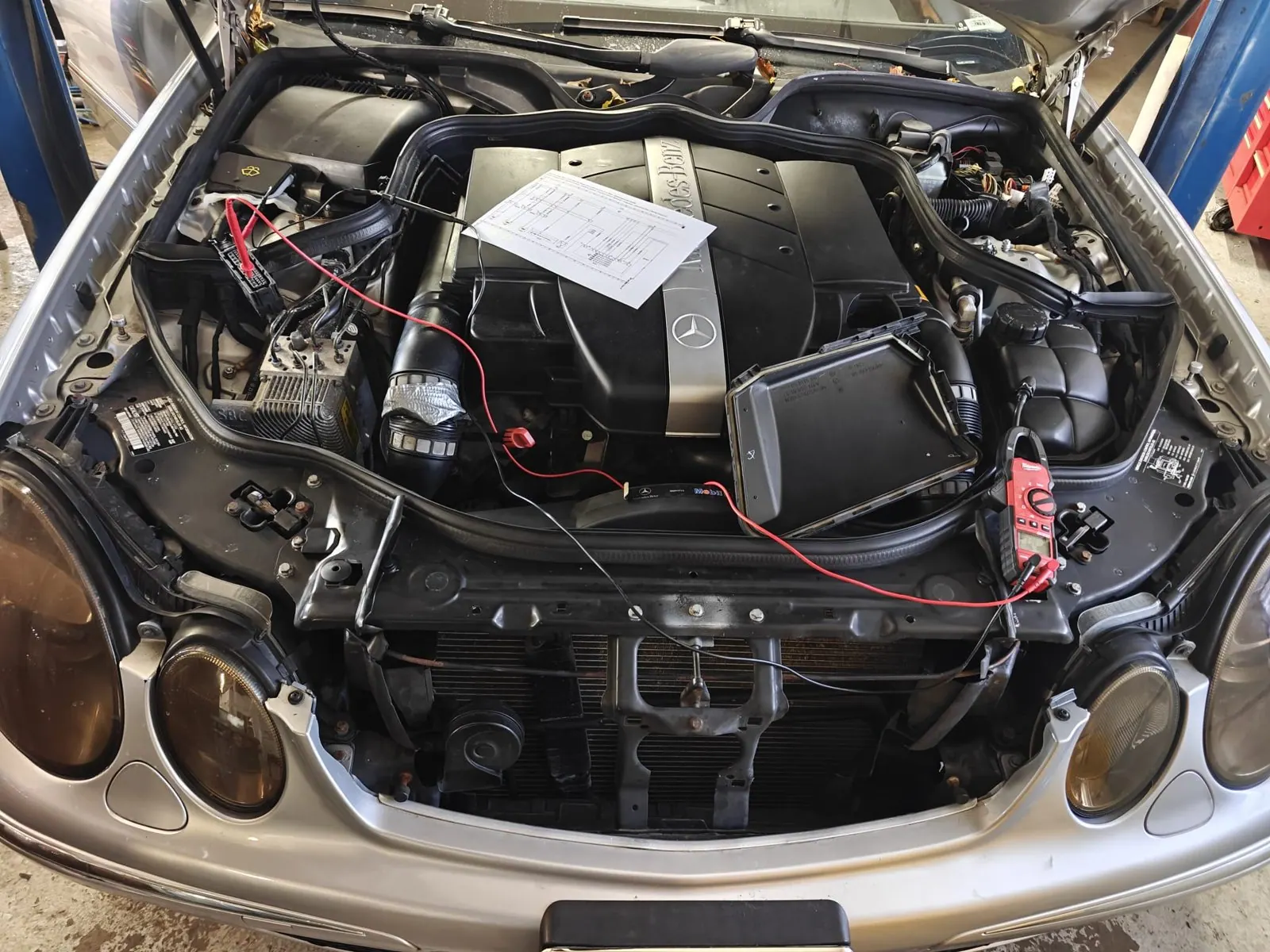
The diagnosis set-up: the wiring diagram on the engine cover, test leads on the SBC connector, a multimeter on the radiator support.
We printed the wiring diagram for the circuit and checked it point by point with a multimeter, back-probing the connectors so the circuit could be measured while connected — at the SBC unit first, then along the wiring toward the rest of the car.
The SBC unit: hydraulic block, brake lines and the electronic module. The test lead is in its connector.
What we found
The readings led away from the SBC unit and to the rear of the car, to a connector on the body behind the trim. Its terminals were corroded green and orange, with rust on the body panel around it — the kind of damage moisture does slowly, over years, in a place nobody looks.
The cause: a connector in the rear of the car with corroded terminals, being measured with the test leads.
Corrosion adds resistance. A circuit that measures fine with no load can drop voltage or lose its signal once current flows, and an electronic system like SBC reads that as a fault. The connector was repaired, and with a clean connection the fault was gone — no SBC unit required.
Diagnosing with the wiring diagram and a multimeter.Testing at the SBC unit.The corroded connector that caused the fault.
FAQ
Questions this job raises
What is SBC on a Mercedes-Benz?
Sensotronic Brake Control, the electro-hydraulic brake system on this generation of E-Class. The pedal is read electronically and the SBC unit’s pump, accumulator and valves apply the brakes.
Does an SBC fault always mean the SBC unit has failed?
No. On this E320 wagon the fault was a corroded connector in the rear of the car. Measuring the circuit first avoided replacing an expensive unit that was not the problem.
Can corroded connectors cause brake system warnings?
Yes. Corrosion adds resistance, so voltage and signals drop under load, and electronic brake systems flag that as a fault.
Is it safe to drive with an SBC warning?
Have it checked before driving further. SBC is the braking system; a warning can mean reduced assistance or a fall-back mode.
Do you diagnose Mercedes electrical problems in Worcester?
Yes. We diagnose Mercedes-Benz electrical and brake-system faults at our Worcester, MA shop, with wiring diagrams and circuit testing rather than guesswork.